


The Imminent Distortion of European Insolvency Law: How the European Union Erodes the Basic Fabric of Private Law by Allowing 'Relative Priority' (RPR)

2. Insolvency law's proper role and the debt-equity divide
3. Cross-class cram-down and the APR in normal reorganisation procedures
4. The Directive on Preventive Restructuring Frameworks, the APR and the last-minute move to EU RPR
6. Is EU RPR desirable? 6.1. EU RPR upends the basic fabric of private law
6.3. EU RPR leads to arbitrary results and value-destroying uncertainty
6.4. EU RPR will specifically be detrimental for SME's
6.5. The Directive will kick start new wave of undesirable comi-migration
7. Should the APR be finetuned and if so, how? 7.1. SME equity retention plan
7.2. Exception for trade creditors

| 1. | Introduction |  |
1.The EU is creating large and unnecessary risks for Europe with last-minute changes to the Preventive Restructuring Directive. This Directive instructs Member States to introduce a reorganisation procedure in which creditors vote in classes on a reorganisation plan which usually entails the creditors losing (part of) their claim, all outside formal bankruptcy. Under the 2016 version of the proposed Directive creditors were protected against shareholders by means of the so-called Absolute Priority Rule (APR). As far as the relationship shareholders-creditors concerns, the APR basically protects creditors in a reorganisation procedure by providing that shareholders cannot retain any value in the reorganized company if creditors are not paid in full, unless the majority of creditors consent thereto. In the recent 2018 version of Preventive Restructuring Directive the APR can be replaced by a newly conceived Relative Priority Rule (“EU RPR”) [7]. The proposed Directive has been adopted by the European Parliament [8]. From the outset, it should be clear that this EU version of the RPR is something completely different from the RPR advocated by US scholars.
The newly proposed rule provides that dissenting trade and other creditors only need “to be treated more favorable” than shareholders. The EU RPR would apply in reorganisation cases where a plan is not accepted by a majority in all classes, but instead is forced upon dissenting classes of creditors by a judge applying the so-called cross-class cram-down provisions contained in the Directive (see more extensively below in nr. 11). This EU Relative Priority Rule as to distribution of value sounds nice and may appear to be protective of creditors, but in reality is more likely to turn against these creditors than to protect them. Although the two rules of APR and EU RPR are presented as alternatives with a difference in degree of protection, EU RPR would allow just for the kind of behavior which the APR seeks to counter, namely creditors losing their claims against a company while shareholders still hold on to the company.
The ramifications of this go well beyond poorly functioning companies that lost out in the survival of the fittest of the market economy. Insolvency law has effect on all contracts with a debtor and a creditor, also outside the immediate prospect of insolvency [9]. If insolvency law is allowed to develop in such a way that it is no longer working for but rather against creditors, the basic fabric of our private law, our market economy and our society changes. By suddenly and without much debate allowing for EU RPR instead of APR, the EU is taking large and unnecessary risks.
| 2. | Insolvency law's proper role and the debt-equity divide | |
2.Insolvency law is collective debt collection law [10]. A company is balance sheet insolvent, when its assets are worth less than the outstanding debts, meaning the assets are not sufficient to pay all creditors in full. Outside of insolvency, in case a debtor defaults, a creditor can go to court and foreclose on the debtor's assets. In case of insolvency the individual approach of debt collection turns out to be counterproductive. An individual creditor will try to seize individual assets, thereby possibly dismantling a viable business, diminishing the total value available for the creditors. Or in the words of Jackson:
“To the extent that a non-piecemeal collective process (whether in the form a liquidation or reorganisation) is likely to increase the aggregate value of the pool of assets, its substitution for individual remedies would be advantageous to the creditors as a group. This is derived from the commonplace notion: that a collection of assets is sometimes more valuable than the same assets would be if spread to the winds. It is often referred to as the surplus of a going-concern value over a liquidation value.” [11].
3.Insolvency law is commonly justified by the notion that an insolvency procedure is beneficial for all creditors together, since it enhances the total value that can be distributed to creditors. The collective procedure of debt collection also reduces costs of creditors which would otherwise arise if creditors would be litigating each other over the limited assets. The dominant insolvency law theory, the Creditors' Bargain Theory developed in the 1980's in the US goes even a step further and seeks to enhance the normative force of insolvency law by arguing that lacking insolvency laws, creditors would ex ante agree amongst themselves upon rules of collective debt collection.
4.Shareholders of an insolvent company are last in line, also paraphrased as: “equity is wiped out first”. This is not unfair, but merely the result of shareholders investing to get the upside of the company. Shareholders provide capital (equity) in return for shares which entitle them to the potential profits of a company. Creditors provide loans or accept delayed payment, which in turn leads to debt. Creditors are thus entitled to a fixed return (if any) in the form of interest. In case of insolvency, the creditors are to be paid before the shareholders receive anything.
This basic corporate finance division between debt and equity is not just descriptive. The presumption that shareholders provide risk-bearing capital forms the foundation of the corporate form with limited liability [12]. Shareholders are entitled to the profits because they are deemed to be the ones that invest risk-bearing capital. Because of limited liability, shareholders cannot lose more than they actually put into the company. In case of insolvency, the primacy of shareholders is replaced by that of creditors. Jackson also presents insolvency law as a kind of expropriation of shareholders for the benefit of creditors: “In bankruptcy the unsecured creditors of an insolvent debtor can be viewed as the new equity owners of the debtor and hence entitled to what the debtor was entitled to outside of bankruptcy.” [13].
5.The Bank Resolution and Recovery Directive (BRRD) [14] also stipulates this basic division as a core principle governing the application of resolution powers:
“Article 34
General principles governing resolution
1. Member States shall ensure that, when applying the resolution tools and exercising the resolution powers, resolution authorities take all appropriate measures to ensure that the resolution action is taken in accordance with the following principles:
- the shareholders of the institution under resolution bear first losses;
- creditors of the institution under resolution bear losses after the shareholders (…)” [emphasis added].
| 3. | Cross-class cram-down and the APR in normal reorganisation procedures | |
6.Reorganisation procedures can jeopardize the envisioned debt-equity divide in normal insolvency proceedings. Moreover, reorganisation proceedings and composition plans can provide a setting in which it is more likely that insolvency law turns itself against the creditors. The risk is that, despite the reorganisation procedure, creditors are left with the liquidation value and the shareholders usurp all or most of the going concern surplus. This paragraph will discuss the general working of composition plans as part of a reorganisation and how the APR fits in.
7.The most basic reorganisation plan is one in which creditors in a formal insolvency procedure accept a discount on their claim and expect that they in the end will receive more than they would in case the company and its assets were simply liquidated. With the help of external experts such as accountants, a calculation is made how much creditors can expect to receive in case of liquidation, for example 12.5%. The plan then provides for a higher pay out of say 15%. When accepted, the debt is thereby reduced, the company is viable again and the creditors are better off compared to what they would have received in liquidation. Good reasons why one might want to try to save not only the enterprise, but also the legal entity itself, can be found in licenses and contracts that could not be sold and transferred to a buyer when the debtor has been declared insolvent.
Since it will be near impossible to have all creditors agree to the alternative of reorganisation by means of a plan instead of liquidation, rules on reorganisation procedures usually provide for majority rules. Without such rules, hold out behaviour could arise if one creditor believes that if he withholds his consent to a 15% pay out, he might be able to force the other creditors to concede to allow for his single claim to be paid in full or at least more than the 15% offered [15]. Reorganisation rules therefore introduce majority rules by which a majority can also bind the minority. Most legal systems use a threshold both in amount and in number and allow classes of creditors with similar interests to be created. As a starting point, all classes have to accept the plan.
German law provides the debtor the possibilities to restructure its debts by means of a Insolvenzplan [16]. The creditors can be divided into classes. For the plan to be accepted, within each class at least half [17] the creditors [18] has to vote in favour [19]. The Netherlands apply similarly low thresholds for a plan to be accepted [20]. The English Scheme of Arrangement sets relatively high thresholds with respect to the creditors' consent by requiring the approval of a majority in each class in excess of 75% in value of the creditors present and a simple majority in number [21], which might be surprising in the light of its reputation as a debtor and reorganisation friendly regime. The US under Chapter 11 requires in each class a majority of two-third in amount and a majority in number of creditors [22].
8.The adoption of a plan is not left to creditors' majority vote entirely. In order to prevent plans that would provide that 80% of the creditors would accept a plan that provides that 20% does not receive anything, the court needs to sanction the plan. The court typically cannot sanction a plan that makes some creditors worse off compared to a liquidation if these creditors do not consent. This is generally referred to as the “no-creditor worse off' or as in the proposed Directive the “best interest of creditors” test. Dissenting creditors can thus only be overruled by the majority of their own class after court approval.
9.There is also the possibility that an entire class of creditors votes against the plan and that this should be viewed as harmful hold out behaviour. Some jurisdictions therefore explicitly provide courts with the power to overrule the majority vote in an entire class. The court can do so in case the creditors cannot reasonably have voted as they did and the creditors are not worse off under the plan compared to their position in case of liquidation. This is referred to as a cross-class cram-down. Germany, the US and the Netherlands provide for such cross-class cram-down rules [23]. The UK does not yet explicitly allow for a cross-class cram-down by the court [24]. Again, this can be seen as rather surprising, given the reputation of the English Scheme of Arrangement as a very reorganisation friendly regime [25].
Although the “best interest of creditors” test might seem fine at first sight, the test does not sufficiently protect creditors in case of a cross-class cram-down. The creditors are at risk of receiving only the liquidation value, where the shareholders usurp the going concern surplus. This can be shown with the following example. In case a company is facing liquidation with an estimated liquidation value of EUR 400, the secured creditors with a secured claim of EUR 350 would receive EUR 350 and the unsecured creditors would have to share the remaining EUR 50. If unsecured creditors together have a claim of EUR 400, this would result in 12.5% pay out (foregoing liquidation costs) [26].
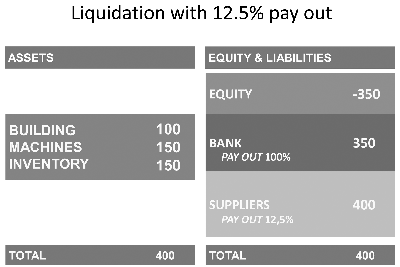
If the “best interest of creditors” test would be the only test and the court would have the power to overrule an entire class, creditors can be forced to be content with any higher distribution than the low water mark (12.5%) of their expected pay out in case of liquidation. In this scenario the creditors would have to accept a pay-out of 15%. The entire starting point is, however, that the company needs to be saved because the company is worth more going concern (e.g. EUR 700) than liquidated (e.g. EUR 400) [27]. If the higher going concern value of EUR 700 is put in the balance sheet after a debt write down to 15% (which reduces the total claim to EUR 60) this results in positive equity, with a value of EUR 290.
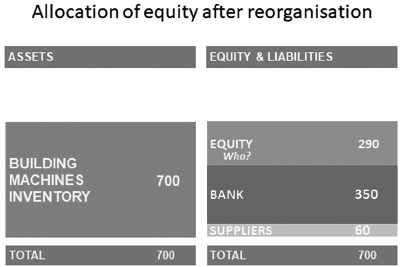
Who gets the EUR 290 generated by the reorganisation? Creditors and shareholders are free to negotiate this. In the US and Germany [28], a court can however not cram down a dissenting class as long as a lower ranking class such as shareholders retain any value in the company. Such a rule is referred to as the Absolute Priority Rule (APR). The APR thereby does not provide that creditors must be paid in full before any lower ranking creditors or shareholders receive anything under a reorganisation plan. If the qualified majority of creditors (two-thirds in amount and a majority in number under US law [29]) were to accept such a plan, this is allowed. The APR simply provides that such a plan cannot be forced on creditors when the majority has voted it down, or in the words of Baird and Jackson: “When a firm owes more than its assets are worth, the shareholders receive nothing unless the creditors consent.” [emphasis added] [30].
10.The APR has a rich history in corporate reorganisation procedures, especially in the US [31]. Already in early cases, the US courts defended the APR grounded on the concern that shareholders and senior creditors would otherwise collude to expropriate junior creditors (unsecured creditors) [32]. Recently, the US Supreme Court has firmly upheld the APR [33], as Lipson summarizes with reference to the case:
“The Court observed that these priority rules-in particular, the APR-have 'long been considered fundamental to the Bankruptcy Code's operation' because, among other reasons, they 'enforce a distribution of the debtor's assets in an orderly manner (...) in accordance with established principles rather than on the basis of the inside influence or economic leverage of a particular creditor.' (…) Thus, the Court noted, the APR is 'quite appropriately, bankruptcy's most important and famous rule' (…) and is 'the cornerstone of reorganization practice and theory.” [34].
Especially the point that the APR, by laying down solid principles, limits inside influence or economic leverage is important to understand. Lipson adds that it also induces parties to reach agreement at the negotiating table:
“Although the APR is largely viewed as a distributive principle, it also has important participatory effects because it can force (or induce) plan bargaining (…) precisely because there may be (residual) going concern value that shareholders wish to preserve, they are likely to negotiate a plan attractive enough to unsecured creditors to obtain affirmative support sufficient to avoid cramdown.” [35].
| 4. | The Directive on Preventive Restructuring Frameworks, the APR and the last-minute move to EU RPR | |
11.With the Directive on Preventive Restructuring Frameworks and Second Chance, the EU forces Member States to implement a preventive restructuring framework (art. 4) with majority voting in separate classes (art. 9). The debtor has to remain at least partially in control (art. 5), which is new to most continental legal systems. Court oversight of the procedure can be limited (art. 5). Member States are also forced (!) to introduce a cross-class cram-down mechanism to implement a plan even if the majority in a class of creditors has not accepted it. All in all, this is a far reaching shift for most Member States towards very reorganisation friendly laws that strongly curtail creditors' rights to demand full payment outside insolvency [36].
The least that can be expected of such a new and invasive procedure that allows a debtor in possession to write down creditors even against their majority vote, is that the boundaries are clear and that adequate protection is built in for creditors. Initially, the 2016 proposal of the Directive stipulated that such cross-class cram-down would only be allowed when both the “best interest of creditors” test and the APR have been abided.
12.In a surprising move, the draft version of end 2018 removed the mandatory basic protection of the APR. The Directive has soon after, end of March 2019, been adopted by the European Parliament. The Directive now provides that a cross-class cram-down complies with either the EU RPR rule or the APR rule, apparently even with a preference for EU RPR. The new article 11 Directive stipulates that:
- (c)(…) dissenting voting classes of affected creditors are treated at least as favourably as any other class of the same rank and more favourably than any junior class [EU RPR]; (…)
- By derogation of point (c) of the first paragraph, Member States may provide that the claims of affected creditors in a dissenting voting class are satisfied in full by the same or equivalent means if a more junior class is to receive any payment or keep any interest under the restructuring plan [APR] [37].
This rule would allow a cross-class cram-down against a dissenting group of creditors, thus partly writing down those creditors against the majority vote, whilst the lower ranking shareholders essentially keep all or part of their shares.
13.The introduction to the October 2018 version [38] provides the following explanation for the change from APR to Relative Priority:
“The cross-class cram-down mechanism was new to a number of Member States and raised some concerns. Two aspects, in particular, were problematic for a considerable number of Member States:
(…) the proposal introduced an absolute priority rule according to which a dissenting class of creditors must be satisfied in full if a more junior class could receive any distribution or keep any interest under the plan.
(…) [This] problem has been addressed in the compromise text by providing an alternative option for Member States to introduce a different benchmark - a 'relative priority rule' - to protect dissenting creditor classes when using a cross-class cram-down mechanism. (…) This provides Member States with more flexibility in implementing this rule.”
This explanation contains a clear paradox: the cross-class cram-down mechanism was new to a number of Member States and raised concerns, and apparently therefore the mandatory inclusion of the APR was removed. All the APR however does is protect against a cross-class cram-down that is not in line with basic non-bankruptcy priorities. So the APR itself is not an invasive new rule. APR seeks to protect creditors from losing their rights and from having their legitimate expectation trumped by the introduction of a cross-class cram-down. If Member States would indeed be concerned about the new mechanism of cross-class cram-down, which they should be, inclusion of the APR that restricts opportunistic use of cross-class cram-down can only be welcomed. As far as we can infer from this limited explanation itself, the EU RPR could be based on a misunderstanding or at least on an imperfect understanding of the working and risks of reorganisation procedures [39].
If Members States would opt for the European version of RPR, this would alter the entire Preventive Restructuring procedure. One should bear in mind that the Directive seeks to provide rules for a Preventive Restructuring Framework. Without full court supervision and without appointment of an external administrator, creditors cannot only lose the overwhelming majority of their claim, but also find the shareholder continue to run the company and retain a majority stake.
| 5. | EU RPR is confusingly labelled as it is completely different from US proposals for Relative Priority | |
14.There is more reason to believe the inclusion of the EU RPR could possibly be based on a misunderstanding. The European Law Institute (ELI) Report mentions that Absolute Priority is also criticised in the US and that also in the US proposals have been made in favour of Relative Priority. However, whereas both proposals bear the same name, these US proposals finetune application of the APR, whereas the Commission proposal negates the APR. The ELI Report criticizes the APR by making references to the work of US professor Baird:
“A more flexible (relative) priority rule would better reflect pre-insolvency entitlements as it allows to create a new capital structure that also keeps everyone in the picture. As Douglas G Baird puts it: 'Such a new capital structure can be consistent with the firm's current financial condition (doing away with such things as the obligation to pay dividends and interest as well as stripping junior investors of voting or other control rights), yet still recognize the junior investors' right to any excess that remains when, at some time in the future, all the accounts are ultimately squared. This is the essence of relative priority.'” [40].
And again, quoting Baird:
“'Much of the complexity and virtually all of the stress points of modern Chapter 11 arise from the uneasy fit between its priority regime (absolute instead of relative) and its procedure (negotiation in the shadow of a judicial valuation instead of a market sale).'” [41].
US RPR is under Baird's proposal indeed more flexible but not along the lines as proposed in the amended 2018 version of the Preventive Restructuring Framework.
15.Under the EU Preventive Restructuring Framework, the senior class only needs to receive more favourable treatment than the lower class, thereby allowing value to unconditionally be allocated to the lower class whilst the senior class is not paid in full, thus disrespecting priority rights. US RPR, as proposed by some, fully upholds the right of senior creditors to be paid before junior creditors and of junior creditors to be paid before shareholders. In as far as the EU was indeed guided by US discussions on RPR, the EU proposal ends up implementing a completely different rule which achieves the opposite results.
16.Contrary to EU RPR, Baird explains the working of the US RPR he has in mind as follows:
“Implementing relative priority is simple. The senior investor is given all the equity in the reorganized firm, and the junior investor is given a call option on this equity with a strike price equal to the amount owed the senior investor.” [42].
What Baird is concerned about is that bankruptcy forces upon all parties too much a day of reckoning. Unlike Madaus [43], Baird considers uncertain judicial appraisal as the main reason for departure from the APR (EU RPR actually leads to more uncertainty, see par. 6.3. below). Based on Baird's standpoint, “the essential difference between absolute and relative priority is the effect of bankruptcy on the exercise date of the call-option component of the junior investment instrument” [44]. Possibly the company might do well in a year or two. To leave all the value with the higher ranking creditors would then be unnecessary and unfair. Therefore, the day of reckoning is postponed, to e.g. three years later on. Thereby, as a starting point all equity is given to the higher ranking class and something akin to an option value remains with the lower class [45]. If this lower class would be the shareholders, this would amount to them getting an option to get the shares back from the creditors in return for paying the creditors in full at that later date. This also means full valuation of the company is unnecessary, which arguably makes negotiations much easier and cheaper.
17.We do not know why exactly the EU RPR was inserted in this form in the Directive, the explanation to this move is too brief to infer this. The label Relative Priority suggests some affiliation with US ideas on Relative Priority of amongst other prof. Baird. In content, US and EU RPR concepts however have little in common.
| 6. | Is EU RPR desirable? | |
18.The last-minute move from APR to EU RPR is hardly substantiated by the explanation. That however does not mean the APR itself is without critique [46]. Certain exceptions to the APR could and should possibly be made. This is where the debate should be. There has however been too little discussion on the EU RPR concept in order to implement it across Europe.
As discussed above, proposals have been made in the US to finetune the APR. The APR can arguably lead to some uncertainty because, although the positions of parties are clear, a valuation of the company needs to be made to implement the APR [47]. However, in our opinion the EU RPR does not solve these problems, but makes matters worse. This point is developed below, discussing how the EU RPR upends the basic fabric of private law (par. 6.1.), how the EU RPR subsidizes shareholders which leads to further overleveraging of companies and instability in the economy (par. 6.2.), how the EU RPR leads to unacceptable uncertainty and thereby actually worsens certain problems associated to APR (par. 6.3.), how EU RPR will specifically be detrimental for SME's rather than protect them (par. 6.4.) and lastly how the choice for Member States between APR and EU RPR will lead to undesirable regulatory competition and COMI-migration (par 6.5.).
| 6.1. | EU RPR upends the basic fabric of private law | |
19.The EU RPR allows setting aside against the majority vote of creditors the basic rulethat senior creditors are to be paid in full before junior creditors and even allows setting aside the rule that creditors are to be paid in full before shareholders. This can probably be traced back to Madaus, who has promoted the idea that the going concern surplus is not something that belongs to the creditors. This has its root in his proposal to have restructuring proceedings governed by a law distinct from the realm of insolvency law, namely restructuring law [48]. He argues that the “the legal ownership of the entity still rests with the shareholders” [49], hence, the extra value extracted in restructuring is considered as shareholders' property no matter whether the creditors are paid in full or not.
20.The idea that the proposed Preventive Restructuring Framework is not insolvency law and that shareholders should thus be allowed to retain value is misguided. There is no magic here and for the non-initiated, the term “preventive restructuring” might be confusing or even misleading. Although there will be no liquidation of the company and not even a formal court supervised insolvency procedure, there will be parties, most frequently creditors, whose legal rights will be curtailed against their wishes and without their consent. Or, in the words of Tollenaar: “On the other hand, in terms of its consequences, the procedure is nothing but an insolvency procedure ('if it's not called a duck, but looks like a duck, swims like a duck and quacks like a duck, it probably is a duck').” [50].
In fact, curtailing creditors' rights against their wishes outside formal insolvency is even more problematic than in formal insolvency. Firstly, the actual need to curtail creditors' rights outside insolvency is much less clear and thus much harder to justify. More importantly, the danger of opportunistic use by shareholders of preventive restructuring is much larger than the danger of opportunistic use of formal insolvency proceedings [51]. Granting old shareholders value whilst curtailing creditors rights is, exactly contrary to Madaus' view, thus more problematic outside insolvency than inside insolvency.
21.Forcing creditors to give up part of their claim cannot be justified from insolvency law theory if, as a general rule, shareholders are allowed to retain value without creditors' consent. A reorganisation proceeding has to be viewed as an alternative approach to an otherwise soon bankrupt business. Taking restructuring proceedings out of the realm of insolvency law, as proposed by Madaus and followed up upon by the EU, stands against the very aim of insolvency law and would paralyse its effectiveness. Moreover, parties' basic priority rights would simply not be respected, without much justification. This upends the basic fabric of private law. Insolvency law is and remains a collective debt collection procedure. If debt collection is pursued by way of reorganizing the company instead of liquidating the company, this alternative strategy should not allow stakeholders to take away value from creditors and transfer this to shareholders.
The ramifications of taking reorganisation law out of insolvency law go well beyond poorly functioning companies that lost out in the survival of the fittest of the market economy. Insolvency law has effect on all contracts with a debtor and a creditor, also outside the immediate prospect of insolvency. In his book, Saving Capitalism, Reich presents insolvency law as one of five basic building blocks of capitalism [52]. If insolvency law is allowed to develop in such a way that it no longer respects the basic fabric of our private law, our market economy and our society changes. By allowing for EU RPR instead of APR, the EU is taking large and unnecessary risks.
| 6.2. | EU RPR subsidizes shareholders which leads to further overleveraging of companies and instability in the economy | |
22.Next to upending the basic fabric of private law, EU RPR disregards that the company to be reorganized did not end up in that state by coincidence. Allowing shareholders to retain shares whilst writing down creditors against their majority vote would not only add insult to injury for creditors, but would also provide a further subsidy to shareholders that incentivizes to overleverage companies, leading to instability in the economy. The subsidy would be paid by creditors and would significantly reduce the downside risk of the investment made by the shareholder. Whereas the traditional and normal risk of a shareholder is that he loses his investment in case of insolvency, this would no longer necessarily be the case.
23.There is a reason why the company ended up needing reorganisation. The company was overleveraged. Pursuing financial leverage is a very attractive strategy for shareholders. By financing the larger part of the activities with debt, instead of equity, the return for shareholders increases significantly. Without changing the company operationally, shareholders can increase their return on equity dramatically by making the company take on debt [53]. This becomes clear if one compares two alternative capital structures of an otherwise same company. Take for example a company with a balance sheet total of EUR 1000 and a Result before interest of EUR 80. If the company is solely equity financed, the Return on Equity for the shareholders would amount to an already decent 8% (left side graph below). If the same company is financed with EUR 350 in bank loans and EUR 400 in credit from suppliers, both against an interest rate of 4%, the Return on Equity for shareholder already increases to 20% (right side graph below) [54].
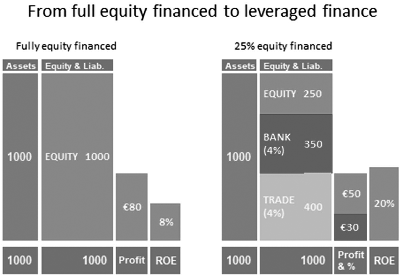
This is the leverage effect of debt and shows the attraction of financing companies with large amounts of debt. The real world of leverage is more complicated and by and large much more attractive for shareholders. Naïve about the previous example was that the assumption was made that trade creditors like banks receive interest on their outstanding claims. A popular corporate finance strategy is to extend payment terms to trade creditors and not pay any interest on these claims. This has a very strong effect on the ROE. If the previous example of the moderately leveraged capital structure with EUR 350 in bank loans and EUR 400 in trade creditors is adjusted to the reality where only banks receive interest and trade creditors are faced with longer payment terms and see their claim increase to e.g. EUR 550 and do not receive interest, the ROE rises further to a very attractive 66%.
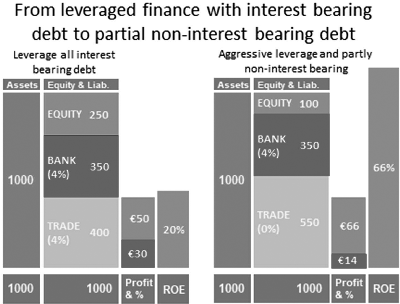
Increasing leverage leads to larger risks. When the cash flows are not enough to cover substantial interest payments, leverage starts to work against the company. Soon the company will become overindebted and will not be able to keep making interest payments. If the company succumbs to its debts, there is however little need to enter full insolvency proceedings, let alone to liquidate the company if the underlying business is sound and still generating cash.
24.The typical company that the Directive is written for is exactly this: a financially overleveraged company with a sound underlying business. Capturing the going concern value for the shareholders, would not only be paradoxical, but also provide a further incentive to shareholders to finance their company with high levels of debt and very little equity. If shareholders are allowed to retain value even in case of insolvency and against the consent of creditors, this would amount to a subsidy of shareholders at the expense of creditors. Subsidizing shareholders of highly leveraged structures is exactly what the EU is trying to prevent with other measures, including the Anti-Tax Avoidance Directive and the Directive on Combating Late Payment in Commercial Transactions. Moreover, allowing value to flow from creditors to shareholders works counterproductively to the goals pursued by the EU in the field of NPLs on the balance sheets of banks [55].
If shareholders would be able to, without liquidating, pay creditors off by only giving them the low liquidation value whilst keeping the shares, there would be a strong incentive to orchestrate that the company becomes balance sheet insolvent and then engage in valuation discussions that are in itself value-destroying. Shareholders might even structure the company in such a way to make sure the liquidation value is particularly low, for example by putting essential assets such as brands in bankruptcy-remote entities and leasing these back to the company. Subsidizing shareholders with creditors' money, as EU RPR allows, in short gives unwanted incentives, including further incentives for overleveraging companies and for orchestrating insolvency.
| 6.3. | EU RPR leads to arbitrary results and value-destroying uncertainty | |
25.As discussed above, the APR can arguably lead to uncertainty because valuation is uncertain, which in turn can lead to costly negotiations. US RPR aims to fix this problem by postponing the day of reckoning and circumventing valuation at present day. EU RPR however only makes matters worse: not only do we need valuation, we also don't know who this value belongs to in the first place. This will lead to more instead of less friction in negotiations and more instead of less room for opportunistic use [56].
26.The EU RPR commands that “dissenting voting classes of affected creditors are treated at least as favourably as any other class of the same rank and more favourably than any junior class”. The concept of relativity of the treatment of different classes may at first seem like a solution that provides flexibility [57], but does this at the cost of serious uncertainty. Creditors have a claim and could get a percentage of pay-out on that claim. Shareholders do not have a claim, they are residual claim holders. Their treatment cannot be measured by a pay-out percentage. Shareholders may have a virtual equity position, but this equity position is usually negative when restructuring a business, so also does not give an amount to take a percentage of. How do we establish whether creditors have been treated “more favourably” than shareholders? That amounts to comparing apples and oranges.
One may think the treatment of two groups of creditors could at least be compared, but again this is in fact not possible. If secured creditors receive 70% and unsecured creditors 69%, who is treated “more favourably”? Secured creditors get a higher percentage, but also had a completely different position, which they bargained for and adjusted their interest rate to. We would therefore be inclined to conclude that unsecured creditors are treated more favourably with these percentages. At what point would that change? What if secured creditors are paid 75% and unsecured 50%? One could even argue that a senior group should be paid in full first, because every penny that goes to a junior group whilst the senior group is not paid in full would amount to more favourable treatment of junior creditors, given their junior position. But this interpretation would mean we are back at the APR.
27.One way out of this is to compare the amount shareholders receive to the amount (in absolute terms) that the junior creditors as a group receive. The language used in the EU RPR seems to support this interpretation. However, such a comparison is still very problematic. Taking this approach, the EU RPR does not take any account of the pay-out percentage to the creditors. A large group of creditors with a combined claim of EUR 300 million could for example get a 2% pay-out which would amount to EUR 6 million. Assume the shares in the reorganized company would for now be valued at EUR 4,5 million and assume the shareholders would retain the full equity position under the plan. EU RPR seems to treat this as a fair result as “the creditors” as a group get EUR 6 million and “the shareholders” EUR 4.5 million, even though the shareholders keep their full position whereas the junior creditors get 2%.
28.That this method of comparing the treatment of groups as a whole to each other is unprincipled becomes even more clear when we add a class of subordinated creditors. Assume these subordinated creditors have a combined claim of EUR 11 million. If they would get EUR 5.5 million, they would get half a million less than senior creditors and one million more than shareholders, which the RPR would treat as “fair”, even though subordinated creditors get 50% on their claim whereas the senior creditors get 2% on their claim. No one could possibly argue that paying a normal creditor 2% and a subordinated creditor 50% would be a fair outcome, but the EU RPR seems to allow this. In short, comparing the treatment of a class as such to the treatment of a junior or senior class leads to arbitrary results. The other problem with this approach is that it puts a lot of pressure on opportunistic grouping of the creditors. Fewer groups result in more value for the shareholder to retain [58].
One could try and think of other ways to somehow compare the equity position to the treatment of creditors, but every effort we have made has resulted in the conclusion that one is comparing apples to oranges. The (explanation to) EU RPR does not offer an explanation of how this would work in practice. This leads us to conclude that EU RPR will inevitably lead to arbitrary results, thus to friction. In that sense, EU RPR leads to more uncertainty instead of less. Not only is the valuation of the company uncertain, uncertain is also who can to which extent claim this value.
29.The EU RPR was purportedly conceived as a solution to hold-out behaviour of groups of creditors [59]. Apart from the adverse effects created by the EU RPR as discussed in paragraphs 6.1. and 6.2. above, possible hold-out behaviour would simply be replaced by very uncertain court decisions on what the court thinks may be a fair plan. Unclear is however what is fair under EU RPR in the first place, and even if that would be clear the valuation is up for discussion. This is an impossible task for courts and will most likely lead to much more cram-down litigation. Whereas the APR incentivizes the shareholder to negotiate and come up with a good plan that is acceptable to all, because the shareholder knows cram-down is only possible after full payment of higher classes [60], the EU RPR incentivizes shareholders to aim for cram-down and engage in costly valuation and fairness discussions. Other parties may also be lured by the prospect of cram-down, because they all think that the plan is not “fair” to them and hope to persuade the court. Next to the fact that this is inefficient, such uncertainty will be exploited by stronger, sophisticated parties at the expense of others.
| 6.4. | EU RPR will specifically be detrimental for SME's | |
30.From the US experience as discussed in paragraph 3., we can infer that the sort of behaviour the APR protects against is collusion between senior creditors and shareholders to expropriate normal creditors. The recent Jevic US Supreme Court case is a good example of such attempted class-skipping [61]. Particularly SME's as creditors are at risk here, because they are often those normal creditors that risk to be skipped. Allowing derogation from the APR, as EU RPR does, especially puts SME's as creditors at risk. The Explanatory Memorandum to the Directive does however seem to suggest that trade creditors will preferably be left out of the restructuring:
“A successful restructuring plan will turn non-performing loans into loans a company can actually pay back. In liquidation, secured creditors have to consider the possibility of substantial reduction in the value of their claims. In restructuring, on the other hand, insolvency is avoided, contract debts are in general paid, and negotiations concern in most cases only the financial debt.” [62].
However, there is no rule in the Directive providing that this is the preferred route of restructuring. This raises the question which kind of companies the Directive is actually seeking to rescue and which types of problems the Directive is seeking to solve. Tollenaar concludes that the Directive is schizophrenic in nature since on the one hand it seeks not to be an insolvency instrument, while on the other, in terms of the procedure and its effects, it is nothing but an insolvency procedure [63]. Eidenmüller is also critical and concludes that the Directive is a twisted and truncated insolvency proceeding [64]. A way of dealing with the protection of creditors would be to simply not allow for a cross-class cram-down of junior creditors. If one deems there might be instances in which one would like to be able to overrule also junior creditors, these junior creditors should at least be protected by means of the APR.
31.Where the Directive seems to be designed for larger companies with a leveraged capital structure with professional creditors, the scope is not clear at all. The risk is that instead of targeting financial creditors, the new preventive framework will be deployed against trade creditors, often Small and Medium Enterprises. The proponents of the EU RPR proposal also seem to want to protect SME's, they write:
“Fourth and finally, the absolute priority rule makes it very difficult to award value, under the plan, to equity. This is particularly problematic in relation to small and medium enterprises in which separation of ownership and control is not feasible because of the size, nature, or location of the debtor's business, and/or because the business is only viable if it were to retain its pre-distress goodwill, which in turn could only be retained if some of the pre-distress management continued to stay in place under the plan.” [65].
Since the scope of the Directive is not clear and there is no limitation of applying Relative Priority to SME's, the outcome is most likely that the Relative Priority Rule will be used by large companies against unsophisticated small creditors, instead of SME's against large sophisticated creditors.
| 6.5. | The Directive will kick start new wave of undesirable comi-migration | |
32.The European Parliament has for a long time been very outspoken against forum shopping and in the context of European Insolvency Law, against comi-migration [66]. Since Relative Priority is “only” introduced as the preferred alternative to protection by means of Absolute Priority Rule, one could argue that there is ample room for the Member States themselves to make up their mind. One should however not underestimate the pressure Member States will be under to provide the most flexibility and the least protection caused by regulatory competition. The introduction of two different systems at a European level will most likely kick start a new round of comi-migration. In the words of A. Mennens:
“Senior creditors will push for a jurisdiction in which their absolute priority rights will be respected, whereas shareholders of financially distressed companies will press for a jurisdiction in which the chances of keeping their interests in the company are higher: jurisdictions that opted for the relative priority rule. This is contrary to the policy of the European Parliament to avoid incentives for parties to move their COMI from one Member State to another, seeking to obtain a more favourable legal position.” [67].
| 7. | Should the APR be finetuned and if so, how? | |
33.EU RPR is an unprincipled and unworkable idea. That does not mean exceptions to the APR should not be possible. As already discussed, there have been proposals in the US to finetune the APR. In its recent proposal for revision of Chapter 11, the American Bankruptcy Institute (ABI) formulated two exceptions [68]. The first exception allows old shareholders to retain part of the equity, if they provide new finance to the company [69]. The second exception proposed by ABI is more novel and would allow shareholders of SME's to retain a stake in case they are instrumental to the continuation of the business also if creditors would not consent as a class, referred to as the “SME equity retention plan” [70]. We discuss this option in paragraph 7.1. below.
Both these exception apply to the relationship shareholder-creditors. Another exception to the APR that we consider worthwhile exploring, is an exception to allow trade creditors to retain value, whilst more senior creditors are not paid in full. This topic is somewhat more complex and would need more deliberation than this article can offer. The basic structure of what such an exception could like is considered in paragraph 7.2. below.
| 7.1. | SME equity retention plan | |
34.In case of SME companies, there could be reasons to allow the old shareholders to retain part of the equity. The specific characteristics and skills of shareholders of large companies are commonly of little or no importance for the actual continuation of the business. In case of a relatively small family owned manufacturing company, producing e.g. violins, on the other hand, the specific skills of the shareholders might be crucial for the continuation and thereby also for the rescue of the company. We are sympathetic to narrow exceptions to the APR that aim to protect SME's. The need for exceptions is however also not obvious. The APR does not block shareholders from retaining a stake, it just blocks shareholders from retaining a stake against the majority vote of one or more classes of creditors. If the shareholder is indeed essential for the continuation of the company, it is also in the creditors' interest to keep the shareholders involved. Moreover, as the quote from Lipson in paragraph 3 of this article showed, the APR can actually aid negotiations between parties by putting pressure on the shareholder that believes there is going concern value to be captured to negotiate a plan in order to avoid cram down.
35.The ABI has suggested an SME equity retention plan. This plan has some similarity to the proposal for Relative Priority as defended by Baird in offering the junior creditors and/or shareholders a call option to at a later date pay the higher class and obtain the shares. This equity retention plan is very different from EU RPR. Unlike EU RPR, it is not a blank derogation from absolute priority, but a rule that protects the principles of absolute priority to a large degree whilst also allowing SME shareholders to stay involved. It provides that the old shareholders of an SME retain 100% of shares. At the same time the unpaid creditors receive 100% of preferred stock with rights ahead of the common shareholders and are entitled to receive e.g. 85% of dividends. This is however a temporary situation. The creditors' preferred interests mature after four years at which time their interests convert into 85% of the common stock. At that moment there is a new status quo in which the old equity holders have 15% of the shares and the old creditors are the majority shareholder with 85% of the shares. Any old shareholder can prevent the creditors getting the common stock after 4 years, by ensuring repayment of the creditors' original claims in full, which payment would also fully cancel the preferred stock position of the creditors.
If one wanted to protect specifically SME's, an exception to APR similar to the ABI SME equity retention plan could be considered. This should be limited to cases in which shareholders can prove their specific characteristics and skills are closely tied to the business and that they have employed these characteristics and skills in the business over the last years. Again, it is not even obvious such an exception is indeed necessary, but this is where the debate should be.
| 7.2. | Exception for trade creditors | |
36.When the underlying business is sound, an insolvency-light regime could suffice, especially if the restructuring would only target financial creditors that have actively financed the overleveraged capital structure. The Directive caters to this need by allowing for tailor-made restructuring plans. Whereas fully-fledged insolvency procedures affect all creditors, the preventive restructuring framework can be limited to certain groups of creditors (art. 14 of the 2016 Directive) and thereby limit the scope of affected creditors, and leave trade creditors, for example, out altogether.
Indeed, a reorganisation of a financially overleveraged company should primarily be an affair between the shareholders and the financial creditors. The majority should be able to bind the minority, outside of formal court-supervised insolvency proceedings, especially if a minority of financial creditors is frustrating a reorganisation that is beneficial for all. The same goes for shareholders that are out of the money. Given the attractiveness of leveraged finance and overleveraging being a problem which can easily be resolved among the financial creditors and shareholders, a preventive insolvency-light regime is well placed to deal with those problems.
37.The APR might however be a problem here. If a certain class of financial creditors shows hold out behaviour and blocks the plan, there may be instances in which it makes sense to allow a cross-class cram-down whilst junior (trade) creditors, such as essential suppliers, retain their full claim. Indeed, recital 28, (a) of the Directive offers the possibility to include such a derogation to the APR. This could indeed be a good possibility if protecting trade creditors is deemed necessary. However, the circumstances under which this exception can be invoked should be crystal clear. This would mean a derogation from bargained for priorities, which should only be allowed on a principled basis and should be clearly justified. One would again have to critically assess if such a derogation from the APR is indeed necessary. It should not be forgotten that the APR only comes into play in a cross-class cram down. If the majority of financial creditors simply accepts a plan which leaves value to lower classes, the APR does not stand in the way of approval of such a plan.
| 8. | Conclusion | |
38.The Directive on Preventive Restructuring Frameworks and Second Chance contains measures in the field of reorganisation plans as part of a preventive restructuring. The first version of the Directive addressed the potential problem that shareholders would usurp the going concern surplus by introducing the Absolute Priority Rule (APR). The rule provides that creditors as a group cannot be forced to accept a reorganisation plan if a lower ranking group, most notably shareholders, still retain value. In the version of end 2018, however, the proposal suddenly and fundamentally changed by allowing for a Relative Priority Rule (RPR) as an alternative approach to the APR. This EU RPR basically provides that dissenting trade and other creditors only need to be treated more favourable than shareholders. Thereby it would allow shareholders to retain all or a significant part of the equity under a reorganisation plan.
39.The analysis above has shown that the introduction of this EU RPR could be based on a misunderstanding. Firstly, the explanation contradicts itself by stating that the cross-class cram down mechanism was new to many Member States, therefore the APR would not be acceptable. The APR however simply protects against opportunistic use of cross-class cram-down. Moreover, the EU may have relied on US discussion and proposals on “Relative Priority”. Whereas these US RPR-ideas aim to take the sharp edges off Absolute Priority without dismantling the core principles, EU RPR is a completely different rule that negates the principles that APR is meant to protect and thereby threatens the basic fabric of private law. In other words, the EU seems to implement the wrong rule, albeit with the same name as the US proposals.
There is also little to like about the now proposed EU RPR. Firstly, the rule disrespects basic priority rules in an unprincipled and unsubstantiated way, such as the basic rule of corporate law that shareholders bear losses before creditors. The ramifications of this go well beyond poorly functioning companies that lost out in the survival of the fittest of the market economy. If insolvency law is allowed to develop in such a way that it no longer respects the basic fabric of our private law, our market economy and our society changes.
40.Secondly, EU RPR subsidizes the overleveraging of companies and incentivizes orchestrating insolvency, by granting shareholders value that based on normal private law rules belongs to creditors. Subsidizing overleverage is something the EU is actually trying to prevent with other measures, such as the Late Payment Directive and the Anti-Tax Avoidance Directive. This also counteracts legislative activity in the field of non-performing loans and is opposed to the principles laid down in the Bank Recovery and Resolution Directive.
41.Thirdly, as far as we can assess, EU RPR cannot work consistently in practice. EU RPR commands the comparison of classes of creditors and/or shareholders that are not comparable. Whereas US RPR aims to reduce uncertainty surrounding the valuation that is necessary for applying APR, EU RPR only creates more uncertainty. Not only is there uncertainty on valuation, unclear is also who this value might belong to in the first place, which is at least clear under APR. EU RPR thus leads to more costly litigation, more room for opportunistic abuse and more friction. Especially sophisticated parties will probably gain from this, others will lose out.
42.Lastly, where the Directive also seems to want to protect SME's and the position of their shareholders, the outcome is much likely to have exactly the opposite effect of undercutting their already weak position. We conclude that adoption of the European version of Relative Priority Rule would be a grave mistake. That does not mean the APR should not be finetuned. We are sympathetic to narrow exceptions to the APR in order to protect SME's and/or trade creditors, but such exceptions need more thought.
We urge Member States not to opt for EU RPR.
| [1] | Rolef de Weijs is professor of National and International Insolvency Law at the University of Amsterdam, visiting professor at the Riga Graduate School of Law, Latvia and attorney/counsel at the law firm Houthoff, Amsterdam. Aart Jonkers is a researcher and lecturer at the University of Amsterdam. Maryam Malakotipour is a student in the Master Law & Finance and a research assistant at the University of Amsterdam. |
| [2] | The European Parliament voted in favour of the proposed text on 28 March 2019. On 6 June 2019 the European Council approved the final text of the Directive, which was published on 20 June 2019, see http://eur-lex.europa.eu/legal-content/EN/TXT/?uri=CELEX:32019L1023. |
| [3] | Voorstel voor een richtlijn van het Europees Parlement en de Raad betreffende preventieve herstructureringsstelsels, een tweede kans en maatregelen ter verhoging van de efficiëntie van herstructurerings-, insolventie- en kwijtingsprocedures, en tot wijziging van richtlijn nr. 2012/30/EU, www.eur-lex.europa.eu/legal-content/EN/ALL/?uri=COM:2016:723:FIN. |
| [4] | De definitieve Richtlijn is te raadplegen op http://eur-lex.europa.eu/legal-content/NL/TXT/HTML/?uri=CELEX:32019L1023&from=EN. |
| [5] | Voyez http://eur-lex.europa.eu/legal-content/FR/TXT/HTML/?uri=CELEX:32019L1023&qid=1565683581167&from=EN. |
| [6] | N.W.A. Tollenaar analyzed the Relative Priority Rule as proposed in the European Preventive Restructuring Framework. He did not discuss Relative Priority as advocated by American scholars, for example by prof. D.G. Baird. |
| [7] | Proposal for a Directive 17 December 2018 of the European Parliament and of the Council on preventive restructuring frameworks, second chance and measures to increase the efficiency of restructuring, insolvency and discharge procedures and amending Directive, 15556/18, 2016/0359 (COD), “Confirmation of the final compromise text with a view to agreement”, article 11. (“December 2018 Directive”). |
| [8] | The European Parliament voted in favour of the proposed text on 28 March 2019 and the European Council approved the text on 6 June 2019 and was published on 20 June 2019, see https://eur-lex.europa.eu/legal-content/EN/TXT/?uri=CELEX:32019L1023. |
| [9] | Reich presents insolvency law as one of five basic building blocks of capitalism. See R. Reich, Saving Capitalism for the Many, Not the Few, London, Icon Books, 2016. |
| [10] | This paper builds in part on previous work and contains some elements there from, most notably the articles. R.-J. de Weijs, “Harmonization of European Insolvency Law: Preventing Insolvency Law from Turning against Creditors by Upholding the Debt-Equity Divide”, European Company and Financial Law Review 2018, (403) and R.-J. de Weijs and M. Baltjes, “Opening the Door for the Opportunistic Use of Interim Financing: A Critical Assessment of the EU Draft Directive on Preventive Restructuring Frameworks”, International Insolvency Review 2018, (223). |
| [11] | See T.-H. Jackson, The Logic and Limits of Bankruptcy Law, Cambridge, Harvard University Press, 1986, 14. |
| [12] | F.H. Easterbrook and D.-R. Fischel, The economic structure of corporate law, Cambridge, Harvard University Press, 1996. |
| [13] | Jackson, The Logic and Limits of Bankruptcy Law, Cambridge, Harvard University Press, 1986, 21-22. |
| [14] | Directive of the European Parliament and of the Council of 15 May 2014 establishing a framework for the recovery and resolution of credit institutions and investment firms (2014/59/EU, L. 173/190). |
| [15] | See on the underlying rationale of majority rules Professor Bork: “It should be obvious that unanimity is completely impractical. It would give any single creditor with a small claim the power to veto the restructuring, and with it grossly disproportionate leverage.” R. Bork, Rescuing Companies in England and Germany, Oxford, Oxford University Press, 2012, 249. |
| [16] | See art. 217-269 InsO. According to art. 217 InsO, the content of an Insolvenzplan is not limited in any way and can therefore contain any measure. |
| [17] | Half of the number of creditors have to vote in favour and those voting in favour should represent at least half of the total amount held by all creditors voting. |
| [18] | Following art. 247 InsO, the debtor also needs to consent. A refusal can, however, be overruled on the basis of art. 247, sub 2 InsO. |
| [19] | Section 244 InsO. See S. Smid, R. Rattunde and T. Martini, Der Insolvenzplan, Stuttgart, Kohlhammer, 2015, 215; “§ 244 Abs. 1 InsO verlangt für die Zustimmung der Beteiligten zum Plan eine doppelte Mehrheit, nämlich eine Mehrheit nach der Zahl der Beteiligten (Kopfmehrheit) und eine Mehrheit nach der Höhe der Ansprüche (Summenmehrheit), bzw. Beteiligungen (§ 244 Abs. 3 InsO).” |
| [20] | Dutch law requires that more than half of the number of unsecured creditors present at the meeting, representing at least half of the total outstanding debt vote in favour. See art. 145 and 268 Fw. |
| [21] | Companies Act 2006, art. 899. |
| [22] | § 1126(c) USBC. |
| [23] | See for Germany, art. 245 InsO. See for the US art. 1129 BA and see for the Netherlands art.146 Fw. See for a further elaboration on the working of these rules below under the discussion of the APR. |
| [24] | See G. O'Dea, “Craving a cram-down: why English insolvency law needs reforming”, Journal of International Banking and Financial Law 2009, (583); J. Payne, “Debt Restructuring in English Law: Lessons from the US and the Need for Reform”, University of Oxford Research Paper No 89/2013, 2013, (12), and R. Bork, Rescuing Companies in England and Germany, Oxford, Oxford University Press, 2012, 253 and N.-W.-A. Tollenaar, “Het Pre-insolventieakkoord. Grondslagen en Raamwerk”, doctoral dissertation, University of Groningen, 2016, § 7.12. |
| [25] | This does not mean that in such a system there is no need for Absolute Priority Rules or that the law thereby would automatically comply with the principles of Absolute Priority Rules. By not allowing for a cram down, all classes basically have to accept a plan. This situation had led to several calls to also come to the possibility of a cram down under English law (see the work of O'Dea and Payne previous note). A consultation paper prepared by the Insolvency Service, contains a cram down, but limits the restriction to a “no-creditors worse off” test (Insolvency Service, A review of the Corporate Insolvency Framework, May 2016, p. 22). In the UK proposal one sees the faulty approach materialise as identified here. The creditors are at risk of receiving only the liquidation value, while the creditors should also be entitled to the going concern value. For an elaborated critique on UK law, see Tollenaar, “Het Pre-insolventieakkoord. Grondslagen en Raamwerk”, doctoral dissertation, University of Groningen, 2016, 22, 267. |
| [26] | The balance sheet here uses colors (the paper version of this article is however in grayscale) to depict the different classes in the capital structure and the size of the blocks depicts their relative position. Since the debts outweigh the value of the assets, there is negative equity. This is depicted also by placing the assets at the level of the economic entitlements. Here it is assumed that the bank is a fully secured creditor. The method of using balances sheets with colors and blocks in relative size to their position is derived from the Financial Mind Map, developed by JBR Institute and J. de Vries©. |
| [27] | One could think that this is quite a lot higher and the spread between liquidation value and going concern value would be unrealistically large. The spread is, however, much smaller than was the case in the infamous Dutch Estro case, where the liquidation value was EUR 4 million and the going concern value well over EUR 10 million. Also, the value of assets stand alone is rather low in general. The real value of assets is realised when the assets are generating cash. |
| [28] | The German rule containing the APR is to be found in art. 245 InsO. Following from art. 245 InsO there are three cumulative requirements for the court to overrule a class that voted against. Namely i) the creditors are not worse of under the plan, compared to a liquidation, ii) the debtor itself or entities related to the debtor do not retain value and iii) no creditor which would rank equally with the dissenting class creditors without the plan, would receive more under the plan. See on the working of this rule: R. Bork, S. Madaus and A. Tashiro, “Plan Issues: Presenting, Voting, Plan Violations, and Allocation Rules” in B. Wessels and R.-J. de Weijs (eds.), International Contributions to the Reform of Chapter 11 U.S. Bankruptcy Code, The Hague, Eleven Publishing, 2015, chapter 7; see also Smid, Rattunde and Martini, supra note 17, 227-266. |
| [29] | § 1126(c) USBC. |
| [30] | D.-G. Baird and T.-H. Jackson, “Bargaining after the Fall and the Contours of the Absolute Priority Rule”, University of Chicago Law Review 1988, (738). |
| [31] | See already: Northern Pacific Railway Co. / Boyd, US Supreme Court (228 U.S. 482) 28 April 1913, Washington 2013. |
| [32] | J.-C. Lipson, “The Secret Life of Priority: Corporate Reorganization after JEVIC”, Washington Law Review 2018, (672) (hereafter, Lipson). |
| [33] | Czyzewski / Jevic Holding Corp, US Supreme Court (137 S. Ct. 973), 22 March 2017, Washington 2017. |
| [34] | Lipson, supra note 2, 645-646. |
| [35] | Ibid. |
| [36] | The assumptions that this far-reaching shift is based on have been questioned, but that is not the focus of this article. See on that point: T. Verdoes and A. Verweij, “The (Implicit) Dogmas of Business Rescue Culture”, International Insolvency Review 2018, (398). |
| [37] | The acronyms APR and RPR were added by the authors. |
| [38] | Proposal for a Directive 16 October 2018 of the European Parliament and the Council of Europe on preventive restructuring frameworks, second chance and measures to increase the efficiency of restructuring, insolvency and discharge procedures and amending Directive, 12536/18, 2016/0359 (COD), “General approach”, 5-6 (“October 2018 Directive”). Considering that the RPR is first introduced in the October 2018 Directive, the paper is referring to that version of the Directive when its text sheds further light on the legislators' perception of the RPR. |
| [39] | The rule seems to come. L. Stanghellini, R. Mokal, C.-G. Paulus and I. Tirado (eds.), Best practices in European restructuring. Contractualised distress resolution in the shadow of the law, Wolters Kluwer, 2018, with reference to Madaus. This EU-funded report mentions additional arguments for EU RPR that the explanation to EU RPR does not mention. According to this report, EU RPR would help against hold-out behaviour and loan to own strategies. However, as our discussion in paragraphs 6.2-6.4 shows, EU RPR allows especially sophisticated parties to opportunistically force trade creditors to accept haircuts. That these trade creditors would be problematic hold-out creditors is unlikely. And rather than helping against loan to own lenders, we fear such sophisticated parties will exploit the uncertainties created by EU RPR. Compare Lipson, supra note 29. |
| [40] | B. Wessels and S. Madaus, Instrument of the European Law Institute, Rescue of Business in Insolvency Law, Vienna, 2017, European Law Institute, 334 available on: www.papers.ssrn.com/sol3/papers.cfm?abstract_id=3032309&download=yes (hereafter, Wessels and Madaus). |
| [41] | Ibid., 333, ftn. 1115. |
| [42] | D.-G. Baird, “Priority Matters: Absolute Priority, Relative Priority and the Cost of Bankruptcy”, University of Pennsylvania Law Review 2017, (785) (hereafter, Baird). |
| [43] | Madaus in Wessels and Madaus, supra note 38; S. Madaus, “Leaving the Shadows of US Bankruptcy Law: A Proposal to Divide the Realms of Insolvency and Restructuring Law”, European Business Organisation Law Review 2018, (615) (hereafter, Madaus). |
| [44] | Baird, supra note 40. The basic idea of relative priority US style can be summarized as follows. Imagine a firm has only one project, and two investors; one investor is entitled to EUR 150 and the other investor will be entitled to whatever remains. Also, after some time they realise that there is an equal chance that the investment either yields to EUR 200 or EUR 0. If one follows the APR approach, all future possibilities would be collapsed to the preset meaning that the investors would be entitled to the values in accordance to the expected value of the project, which is EUR 100 [(0.5 (EUR 200) + 0.5 (EUR 0)]. In that case, the senior investor should receive 100% of the securities issued by the reorganized firm, and the junior investor should receive nothing. However, the RPR that Baird advocates avoids collapsing all future possibilities to the present value. Therefore, instead of allocating the value based on the expected value of the project, one can calculate the expected investment value of each investor based on the likely equal outcomes of the project. The expected value of the senior investor's investment would be EUR 75 [having an equal chance of being paid EUR 150 (if the project succeeds) or EUR 0 (if the project fails)]. Also, the expected value of the junior investor's investment would be EUR 25 [having an equal chance of being paid EUR 50 or EUR 0]. Considering that the project may ultimately be worth more, the existence of an option enables the investors to postpone the day of reckoning. The junior investor would be willing to pay up to EUR 25 as a premium to acquire an option, which grants him the right (not an obligation) to acquire the project in a year from the senior investor in exchange for EUR 150. If the project fails, the junior investor (holder of the option) walks away with nothing. However, if the project succeeds, it yields to EUR 200. Therefore, in that case, the junior investor will exercise the option, buy the shares from the senior investor for EUR 150 and be entitled to the remaining value (EUR 50). It is crucial to note that the option protected the investors from uncertain valuations. Also, no matter the project fails or succeeds, the junior investor would only be entitled to value after the senior investor is fully paid off. |
| [45] | Baird, supra note 42. |
| [46] | See critical S.-J. Lubben, “The overstated Absolute Priority Rule”, Fordham Journal of Corporate and Financial Law 2016, (581). |
| [47] | See however Lipson, supra note 32, 674, arguing the working of the APR reduces risks of “seriously erroneous judicial valuations”. |
| [48] | Madaus, “Leaving the Shadows of US Bankruptcy Law: A Proposal to Divide the Realms of Insolvency and Restructuring Law”, supra note 43. |
| [49] | Madaus in Wessels and Madaus, supra note 40. See also S. Madaus, “Rescuing companies involved in insolvency proceedings with rescue plans”, NACIIL Annual Report 2012, available on: www.papers.ssrn.com/sol3/papers.cfm?abstract_id=2271979&download=yes, the author states as follows: “It is quite obvious that creditors are not entitled to a reorganisation surplus value by the legal position based on their claim against a debtor as equity interest is not part of the debtor's estate and thus not part of a creditor's entitlement under the law of execution or insolvency law.” The author further states that “Additional protection by an APR against a distribution of wealth under insolvency law to the benefit of other parties than creditors does not seem necessary as creditors cannot claim additional value under non-bankruptcy law”. |
| [50] | N.-W.-A. Tollenaar, “The European Commission's Proposal for a Directive on Preventive Restructuring Proceedings”, Insolvency Intelligence 2017, (65) (hereafter, Tollenaar, The European Commission's Proposal for a Directive on Preventive Restructuring Proceedings). |
| [51] | Informal insolvency contracts can often be terminated by counterparties, good employees may walk away, the reputation of the company will be severely damaged and the debtor will usually fully lose control to a court appointed practitioner. |
| [52] | Reich, supra note 7. |
| [53] | This paragraph serves as reminder of the attractiveness of leveraged finance as well as the already precarious position of trade creditors. Furthermore, it highlights that in designing insolvency rules, legislators should not be blind to the reasons why companies take on too much debt. Even more important is that legislators should be concerned about whether insolvency rules might increase the attractiveness of too much debt finance by reducing the down side risks for shareholders of aggressive leverage. See for a more extensive introduction into leveraged finance and the concept of Return on Equity, also discussing basic Corporate Finance Theory, R.J. de Weijs, “Harmonization of European Insolvency Law: Preventing Insolvency Law from Turning against Creditors by Upholding the Debt-Equity Divide”, European Company and Financial Law Review 2018, (403) and R.J. de Weijs, “Secured credit and partial priority: Corporate finance as a creation or an externalisation practice?”, European Property Law Journal 2018, (7). Both articles are accessible online and open access. |
| [54] | Out of EUR 80 profits, EUR 30 interest needs to be paid first, which leaves EUR 50 dividend. |
| [55] | Granting shareholders value that according to basic private law belongs to creditors subsidizes shareholders at the cost of creditors, amongst whom banks are a large group. The NPL-problem will thus be made worse by allowing RPR. See for an overview of the actions of the EU institutions: www.ec.europa.eu/info/business-economy-euro/banking-and-f inance/financial-supervision-and-risk-management/managing-risks-banks-and-financial-institutions/non-performing-loans-npls_en (last accessed 5 March 2019). |
| [56] | Compare Lipson, supra note 32, 680: “(…) uncertainty increases the risks of strategic litigation and expropriation. Because absolute priority is axiomatically more certain than relative priority, it would appear to be a less costly default rule.” |
| [57] | See R. Mokal and I. Tirado, “Has Newton had his day? Relativity and realism in European Restructuring”, Eurofenix, 2018/19, (20), comparing the move from APR to RPR to the move from Newtonian absolutism to Einsteinian relativism (hereafter, Mokal and Tirado). |
| [58] | The RPR commands that a senior class should receive more than a junior class. If all unsecured creditors would be grouped together in one class, the shareholders can receive almost as much as this whole, large class, which could be a substantial amount. If we would however regroup and make 4 distinct groups of unsecured creditors (preferred creditors, employees, trade creditors, involuntary creditors), each group as such would have to get more than the shareholders, which waters down the amount the shareholders get with a large factor. Thus, it would be of utmost importance for the shareholder to create as little voting groups as possible. The more (partly) out of the money groups of creditors that are created, the closer one would get to outcomes close to an Absolute Priority Rule, at least as far as the relationship creditors-shareholders is concerned. And what if we create more groups of shareholders? Would they each be allowed to take a bit less than the most junior group of creditors? |
| [59] | See ftn. 37 above. |
| [60] | Lipson, supra note 32, 672-674. |
| [61] | Czyzewski / Jevic Holding Corp, supra note 30. |
| [62] | Proposal for a Directive 22 November 2016 of the European Commission on preventive restructuring frameworks, second chance and measures to increase the efficiency of restructuring, insolvency and discharge procedures and amending Directive 2012/30/EU, COM (2016) 723 final, Explanatory Memorandum, 13. |
| [63] | Tollenaar, The European Commission's Proposal for a Directive on Preventive Restructuring Proceedings, supra note 50, 71. |
| [64] | Eidenmüller is critical as to the lack of checks and balances on which companies will be allowed to use the preventive framework. He is especially critical since the Directive does not distinguish between viable and non-viable businesses. He fears the proposed Directive will “attract non-viable firms like light attracts mosquitos”. See H. Eidenmüller, “Contracting for a European Insolvency Regime”, European Business Organisation Law Review 2017, (273) 288. |
| [65] | Mokal and Tirado, supra note 57, 22. |
| [66] | In 2011, the European Parliament gave its view on comi-migration when it adopted its proposal for the harmonisation of European Insolvency Law. The European Parliament apparently held comi-migration as such a dubious practice that it warrants harmonisation of substantive insolvency law throughout Europe. See Resolution with Recommendations 15 November 2011 of the European Parliament to the Commission on Insolvency Proceedings in the context of EU Company Law (2011/2006(INI)). |
| [67] | See A. Mennens, “Puzzling priorities: harmonisation of European Preventive Restructuring Frameworks”, Oxford Business Law Blog, 25 March 2019, available on www.law.ox.ac.uk/research-subject-groups/commercial-law-centre/blog/2019/03/puzzling-priorities-harmonisation. |
| [68] | See M.-M. Harner, “Final Report of the ABI Commission to Study the Reform of Chapter 11”, Book Gallery, 2014, available on www.digitalcommons.law.umaryland.edu/books/97 (hereafter, ABI Report). |
| [69] | See ABI Report, supra note 68, 225-226. |
| [70] | ABI Report, supra note 68, 296-299. The working of the SME equity retention plan is quite elaborate and will be of interest for both insolvency and corporate lawyers. It provides that the old shareholders retain 100% of the common stock and are entitled to receive 15% of any dividends. At the same time the unpaid creditors receive 100% of a class of preferred stock and are entitled to receive 85% of dividends. Taken together, one could wonder whether this would provide sufficient stimulus for equity holders to continue to work for the rescue and reorganisation of the company. This is however a temporary situation and therefore not the end. The creditors' preferred interests mature after 4 years at which time their interests convert into 85% of the common stock. At that moment there is a new status quo in which the old equity holders have 15% of the shares and the old creditors are the majority shareholder with 85% of the shares. Any old shareholder can prevent this conversion after 4 years, by ensuring repayment of the creditors' original claims in full. |

